Do you need some Wikipedia?

Resultados de la búsqueda

30 jun 2016

LEGENDS of 1ºESO

Daytrip: LEGENDS OF TOLEDO


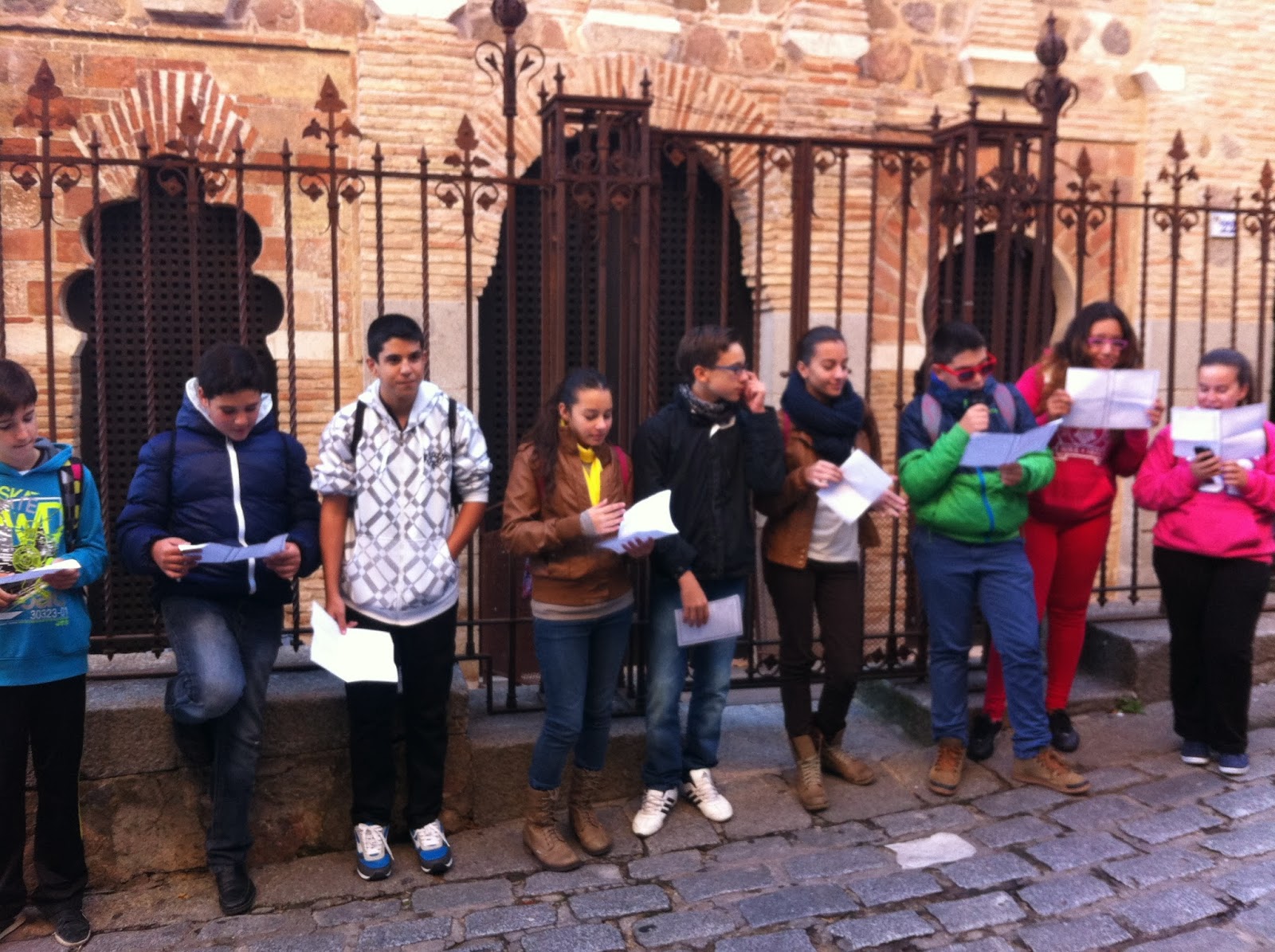
Last 17th of May all 1st of ESO bilingual students spent a great day in Toledo. 

We had a city tour in which students dramatized the following legends:


  1. The legend of La Vega Christ
  2. The Legend of the Christ of the Light 
  3. The Legend of Alfileritos
  4. The Legend of The Bitter Well

Students acted like jewish, christians and muslims in the city. 
They became kings, ladies, servants and kinghts in the streets of Toledo.

 We also visited monuments, read poems in English and Spanish by Bécquer, followed maps,interviewed tourists in English, 
took a lot of photos and... had a lot of fun!!!


Have a look at some of our photos.


16 jun 2015

Diplomas and Cerfificates for 4ºESO Bilingual students


Bilingual Program DIPLOMAS and CERTIFICATES for 4º of ESO

June 2015,  students that have finished 4º of ESO in the Bilingual Program have been awarded by "Julio Verne" High School for their continuous effort during these years. 
They are all happy with their level of English and the achieved goals.


We wish them the best in their future studies!!!

1 jun 2015

DAYTRIP TO TOLEDO 1st of ESo

DAYTRIP TO TOLEDO in English!!


Last 28th of May the bilingual students in 1st of ESO were not at school, because we spent the morning in Toledo. We had a great city tour in which we:


27 oct 2014

Mind maps

Mind maps: Success in studies

Mind Maps are a way of displaying information.
They help you remember important points.
They are used to simplify complex topics.
They help your brain to make relationships.
Their visual quality and colour stimulates your memory.
They improve your ability to manage information and the flow of your ideas. This increases concentration and confidence in students.

Interested in creating your own Mind Maps?

Then follow these steps,and be as crative as you want:

  1. Prepare an A4 paper and some colours.
  2. Place a topic in the center of the page.
  3. Brainstorm ideas about it. Use key words and short sentences(Try answering what, why, where, when or how to start)
  4. When you generate ideas, draw branches around the main topic.
  5. Draw some sub-branches from your main branches to extend your thoughts and create associations between ideas.
  6. Draw lines between toughts. Curve lines will stimulate your brain. Use the same colour to associate ideas and different colours to separate them. 
  7. Draw or find pictures for each branch or sub-branch. Make each picture significant, funny or exaggerated. Images help us to remamber more easily.
  8. If all your ideas appear on the paper: You have created a mind map!
  9. You can try sites like this one to create mind maps on linehttps://bubbl.us/  

16 jun 2014

Video "THIS IS MY SCHOOL"

2nd of ESO students have been working during this school year in a PENPAL- PROJECT.

We have sent, and received, e-mails to the students from Magdalen Court School from EXETER – UK.
Students have prepared this video to show our school “Julio Verne” High School to their friends in England. Have a look!!


Congratulations to 4th of ESO students!!


Look how happy they are with their Diplomas and Certificates after studying in the Bilingual program of the school.
We wish you the best of lucks in your future studies.


5 ene 2014

FIELDTRIP TO TOLEDO, 2ºESO

Hello friends!!
Did you know that last 14th of November the 2ºESO Bilingual students went to Toledo?
These are some of activities we did:
ü  Groups of students gave explanations of significant monuments of the city in English  (Bisagra Gate, Gate of the Sun, Mosque of Christ of the Light and Primate Cathedral).
ü  We had guided tours in English –offered by “Consorcio Toledo”- in the Roman Baths and the Hercules Caves.
ü  Students interviewed foreign tourists who were visiting Toledo.
All the participants (included our conversation assistant, Diana Greene) enjoyed a great sunny day of excursion in the city.
As you can imagine, we took many photos; do you fancy seeing some of them?

27 may 2013

EXPLORING ANCIENT CIVILIZATIONS

1st of ESO students have been studying old civilizations.
We have learnt many interesting aspects about these people (periods of time, houses, cities, buildings, monuments, transport, food, clothes, schools and education, language, sports and games, entertainment, toys and games, art, gods and beliefs and VIP).
We spoke in the classroom about them, and some of us dressed up as EGYPTIANS, MESOPOTAMIANS, GREEKS and ROMANS for the day of the oral presentations.
Have a look at some of our photos!

18 nov 2012

UNITED STATES, HISTORY and MUSIC

Imagine we are in Yorktown, North America, in the 18th century;
suddenly, you listen to an army band of drummers and fifers marching joyfully and playing this
Yankee Doodle
 
YANKEE DOODLE LYRICS

Yankee Doodle went to town,
A-riding on a pony,
He stuck a feather in his hat
And called it macaroni.

(CHORUS) Yankee Doodle, keep it up,
Yankee Doodle dandy,
Mind the music and the step,
And with the girls be handy.

Father and I went down to camp,
Along with Captain Goodin',
And there we saw the men and boys
As thick as hasty puddin'.

(CHORUS)

And there was Gen'ral Washington,
Upon a slapping stallion,
A-giving orders to his men-
I guess there was a million.

(CHORUS)

A long war then was fought and won:
The British were defeated,
And Yankee Doodle was the march
To which their troops retreated.

 
AFTER LISTENING,
Search about this song historical background. Can you answer to these questions or are you a real YANKEE DOODLE? The lyrics will help you!
a)      Was this song first sung by British or American troops? Search an explanation for your answer.
b)      Who were the Yankees? What “long war was fought” then? Which troops “retreated” at the end?
c)        Why is this considered today as an American patriotic song? Base your arguments on history and on some stanzas of the song, if possible.
d)      About language:
·         “Macaroni” is a term that has to do with fashion; find other words in the song connected to 18th fashions.
·         Make the list of the irregular verbs that appear in the lyrics.
·         From what language are the expressions “a-riding” and “a-giving” a remainder?


9 may 2012


INVITATION to the movie “MOULIN ROUGE” in English.
TO: all SECCIONES EUROPEAS students in “Julio Verne” Highschool.
WHERE: in Casa de Cultura of Bargas.
WHEN: Thursday 24th of April, from 11:30 to 13:30.

Do you want to sing the songs of the movie like the actors…?
Enjoy the great music and practice with your classmates with the following
karaoke videos...!

“LADY MARMALADE”
“YOUR SONG” (1ºeso)
“ONE DAY I´LL FLY AWAY” (2ºeso)
“ELEPHANT LOVE MEDLEY”(3ºeso)
“SPARKLING DIAMONDS” (4ºeso girls)
“ROXANNE TANGO” (4ºeso boys)

17 feb 2012

Wheels in the workshop

Here you have some wheels made by 3ºAC bilingual class. They have built them in the workshop and at home.
The wheels are very original and really work.
Wheel 1

Wheel 2
Wheel 3
Wheel 4
Wheel 5
Wheel 6
Wheel 7
Wheel 8
You can vote for the best.Please write a coment.

10 feb 2012

Charles Dickens aniversary

CHARLES DICKENS´ BIOGRAPHY


After watching the video try to answer at least 10 questions about his life.

Once you have written the answers, show them to your English teacher, and you´ll have a reward!!

Questions about the video (choose ten):

1.      We are celebrating Charles Dickens´ anniversary, when was he born?

2.      Who was John Dickens?

3.      Where Dickens´ family moved to in 1822?

4.      How old was Charles when he had to work in a factory 11 hours a day?

5.      Who did he visit in prison every Sunday?

6.      Although he worked as a clerk in a solicitor´s office and as a journalist in a paper, what was his real passion?

7.      When was his first piece of fiction published and when did he marry Catherine?

8.      Do you know what pet he had?

9.      Where did Charles and Catherine travel in 1842?

10.  Who was Helen Ternan?

11.  Which incident left Dickens shaken and ill?

12.  How old was he when he died?


Video 2

DICKENS IN MODERN LONDON

Enjoy this video about London, and try to answer these questions on the blog.


·         What does “Dickensian” mean in modern English?

·         What is a “public house” today?

·         Who was Mr Scrooge?

·         When do we use “What the dickens is that?”

·         How is Westminster Abbey related to Charles Dickens?

24 may 2011

Acrosport from Physical Education


Check out this sweet video!

Questions:
1. What are ways to transition between positions?
2. How many positions do the girls in this video do?
3. How many people are participating in forming the positions?

14 abr 2011

TEENAGERS AND NEW TECHNOLOGIES


The new information and communications technologies (ICT), which include, among others, computers, Internet, mobile phones and video consoles, have brought a huge change in the way we communicate and get information. However, they have also brought new risks and pathologies, especially among teenagers.
Risks:
According to many surveys among teens and parents, the main risks deal with: contents, contacts, addictions and commerce on Internet.
  • Teenagers can come in contact with explicit sexual images and pornographic sites, sometimes through innocent search, hyperlinks in spam or pop-ups that appear on the screen. They can also confront with images that they consider horrible, violent or disgusting, and racism on the net.
  • Chatting is a normal practice in the lives of most of teenagers. 52,2% chats with contacts they know only virtually, and 1 out of 5 has already had experiences with an adult pretending to be an adolescent in a chat-room.  Sometimes there may be negative contacts between teenagers, 1 out of 3 can testify bullying via internet or GSM.
  • Specialists in addictive behaviour in hospitals have, in recent years, doubled the number of visits from adolescents, who look for help to overcome the compulsive use of video consoles, Internet, or messenger…
Recommendations
  • Critical and responsible use of ICT: all users carry part of their responsibility.
  • It is necessary to inform teenagers, parents, educators, schools etc.
  • Inter-generation dialogue: adolescents find their parents' role essential. They appreciate a constructive dialogue about ICT activities and experience, more than a simple repressive talk.
  • Early detection of symptoms of ICTs addictions: in order to put teenagers suffering this disorder back on a normal life.
  •  Need for parental implication: after a dialogue parents must fulfil their regulating role.
For more information: http://dubestemmer.no/en/

Questions:
  1. Give examples of the main risks of new technologies for teenagers?
  2. When you are using Internet, and giving a lot of information about you, who is responsible?
  3. Is it important to talk with your parents about ICTs activities and experiences? Why

10 mar 2011

Daytrip to Toledo


Check out our cool trip to Toledo!! Hello students of 1º ESO!!!!!!!

On last Friday we took a trip to Toledo to see the sites and monuments of this ancient city. With our Technology and History teachers we discovered many facts and surprises about of very near capital city. In spite of the weather, we had had a wonderful day!

Questions for 1º ESO! Give it a shot!
1. What are the most beautiful monuments you saw in Toledo?
2. How many different arches did you see? What are they made of? What are the styles?
3. Give some information about your best interview of foreign people.
4. Did you have fun?

Thanks!!

15 feb 2011

Technology Project

Now, in our technology lessons we are making our technology project. It is a big wheel. It consists of making a big wheel, the way we want. It has to be of cardboard, but we can use wood too for doing some things which have to be made of wood, such as the cabins, because a big wheel has seats for people. We can also use wood for holding up the big wheel. It also has to wear a motor which makes the big wheel turn. These are the most important things about our technology projects.

Questions!!!!!

1. What did you find most entertaining?
2. What was most challenging?
3. What kind of problems did you have in creating the big wheels?


25 ene 2011

Exchange Video with St. John Fisher School


This is the presentation video our European Section students in 2º and 3º have sent to our exchange partners at the St. John Fisher School in Wigan, Manchester, UK.
Our students are conducting an email exnchange with students that are studying Spanish at St. John's. They have the opportunity to discuss interests and cultural differences with their English Partners. 

Video Activity


Learning Languages is vital!!!


Check out this entertaining video about a fish learning to speak a very useful language for him!!!!

Answer the following questions in the Comment section.
1. Are you the clever fish?
2. Which languages could be useful to you?
3. Should the cat learn a foreign language? Why?

Thanks for your responses!

19 ene 2011

Welcome!

Welcome to the official blog of the Sección Europea at the IES Julio Verne in Bargas, Toledo.

We are a bilingual program teaching various subjects to ESO students in English! The program has been in existence in our school since 2008. This school year we have approximately 85 students in the program. The subjects currently offered include; Technology, Physical Education, and History and Geography.


Enseñanza de asignaturas en Inglès en la ESO.